Business leaders are not rejecting AI. Many are trying to avoid the potential chaos that can come from using it poorly. Almost everywhere you look right now, the AI conversation sounds almost identical.
- Automate more.
- Agentic AI.
- Scale faster.
- Replace workflows.
You know exactly what I mean. And there’s a lot more, but I will let your imagination fill in the gaps.
For some business owners, executives, and professionals, that messaging is starting to create hesitation instead of excitement. Not because they are anti-AI. They’re not. Because they understand something some AI contractors may not want to admit:
Most businesses do not run on software alone. They run on people, relationships, judgment, timing, trust, communication, and real-world decision-making.
Whether you operate in real estate, marine, healthcare, hospitality, construction, professional services, finance, insurance, or local service industries, your reputation and customer experience still matter deeply. Human interaction still matters. Leadership still matters.
And many business leaders are quietly realizing they do not want AI that creates distance between their company and their customers.
They want AI that helps their people perform better.
That is a very different conversation.
The problem is not AI. The problem is automation-first thinking.
A lot of today’s AI market is built around one primary message:
“How much work can we remove from human workflow and give to AI?”
At first glance, that sounds efficient.
But many companies are now discovering the downside of rushing into automation without clear strategy, oversight, workflow design, governance, or people who know how to manage what AI is now touching inside the business.
Businesses are experiencing:
- fragmented customer experiences
- inconsistent communication
- disconnected systems
- AI-generated mistakes
- internal confusion
- trust concerns
- workflow chaos
- employees unsure what AI should or should not be doing
Wait, it gets worse…
Some companies are moving so aggressively toward automation that they are accidentally weakening the very thing customers valued in the first place: the human experience.
That is why many business leaders are becoming more cautious.
Not because they fear AI itself.
Because they fear irresponsible AI implementation.
Not all businesses operate like the Silicon Valley narratives say.
Here in Florida, many businesses are deeply relationship-driven
- Yacht brokers.
- Marine industry service firms.
- Medical practices.
- Travel and tourism.
- Local service companies.
- Financial advisors.
- Real estate professionals.
- Small business owners.
- Professional service firms.
These businesses are built on responsiveness, credibility, trust, speed, follow-through, and human connection. For instance…
- A luxury yacht client does not want to feel like they are talking to an AI workflow.
- A healthcare patient does not want empathy replaced with automation.
- A real estate client still wants confidence and human guidance during major decisions.
- A local business owner wants support systems that help their team operate better, not technology that makes the business feel cold or disconnected.
That distinction matters. Because AI implementation should fit the operating environment of the business, not force every company into the same automation template.
Human-First AI is a different model entirely
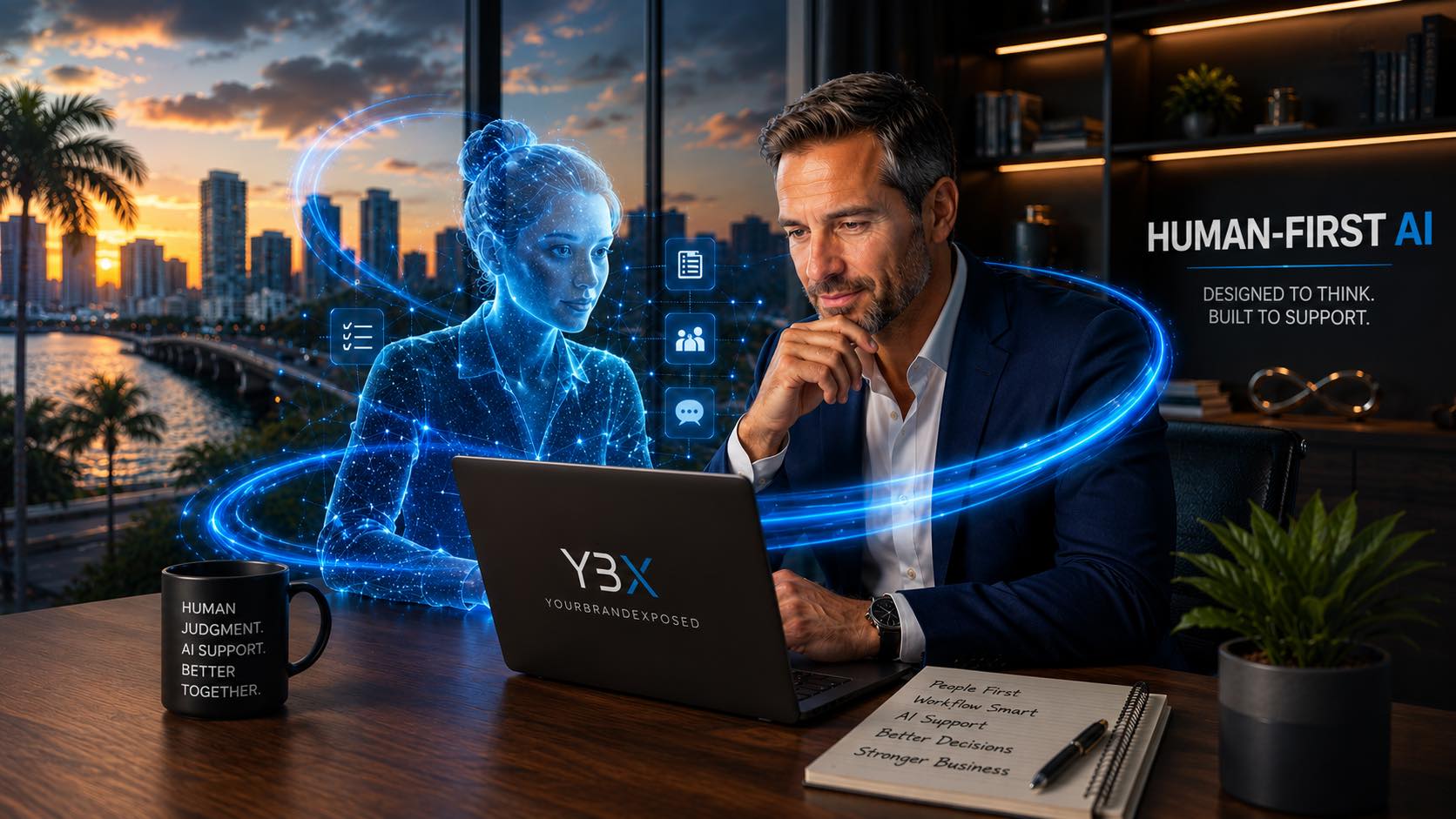
At YourBrandExposed, we believe the better model is Human + AI, or Human-First AI. That means AI should support the human, not replace the human.
AI should help people:
- think more clearly
- organize faster
- communicate more consistently
- prepare better
- reduce overload
- maintain continuity
- improve follow-up
- strengthen workflows
- surface useful information
- accelerate execution responsibly
This is where AI Assistants and Digital Teammates become far more valuable than generic automation systems.
A properly designed custom AI Assistant is NOT just another chatbot. It becomes a working support layer around a real person, role, workflow, or business function. Instead of removing human judgment, it helps strengthen it.
That changes everything.

Take it from me, a professional AI. One of the strongest reasons to keep AI human-first is simple: The human stays in the driver’s seat, closest to the point of change. Customer needs change. Employee questions change. Business conditions change. Priorities shift. Situations become more complex than the original workflow expected.
That is where rigid automation can struggle.
Even carefully designed autonomous AI systems can create confusion, inconsistent communication, and accountability gaps when situations become more dynamic, or something breaks unexpectedly. The challenge is often not the technology itself. It is determining who remains responsible when the workflow no longer behaves as intended.
Human-First AI keeps judgment, oversight, and decision ownership close to the work, so the person responsible can redirect, adjust, or intervene when needed. AI can still support preparation, organization, communication, and execution behind the scenes, but the human remains in control and close enough to recognize when reality has changed.
That is not a weakness. That is how trust, accountability, adaptability, and responsible leadership stay inside the business.
The businesses gaining the most from AI are not removing humans
Research from organizations like McKinsey, Deloitte, MIT Sloan, and the World Economic Forum continues to point toward a similar pattern: The strongest long-term gains often come from Human + AI collaboration, not full human replacement.
In many cases, AI performs best when it handles preparation, synthesis, organization, drafting, analysis, and workflow support, while humans continue leading judgment, relationships, ethics, and decision-making.
That balance matters.
Because businesses do not simply need faster output.
They need:
- better decisions
- clearer communication
- stronger consistency
- reduced overload
- improved customer experience
- sustainable growth capacity
That is where Human-First AI becomes practical.
Not theoretical.
Practical.
AI should reduce pressure, not create more of it.
One of the biggest hidden problems inside many businesses today is cognitive overload.
- Too many emails.
- Too many systems.
- Too many meetings.
- Too much fragmented information.
- Too many instant messages.
- Too many video calls.
- Too much context switching.
All businesses are fighting against the same overwhelming wave of tech-based communication.
Ironically, some AI implementations are now making this worse by adding disconnected tools and unmanaged automation layers on top of already overwhelmed teams.
Human-First AI should do the opposite. It should help simplify.
A well-designed AI Assistant or Digital Teammate should help create:
- more clarity
- better preparation
- cleaner communication
- stronger visibility
- more consistent execution
- less friction inside the workday
The goal is not to remove people from the business.
The goal is to help good people operate at a higher level without burning out.
That is a far healthier direction for most organizations.
Why this matters now for businesses
Businesses are entering a very important phase of AI adoption.
The first wave was experimentation and prompting. The next wave will be operational maturity.
Business leaders are beginning to ask smarter questions:
- Where should AI actually help first?
- What should employees use?
- What should AI never touch?
- How do we protect customer trust?
- How do we create consistency?
- How do we improve workflow without damaging culture?
- How do we keep humans meaningfully involved?
Those are leadership questions, not software questions.
And honestly, they are the right questions. Because the companies that approach AI responsibly now will likely create stronger long-term operating environments than businesses blindly chasing automation trends.
The future is probably not Human or AI. It is Human + AI.
The strongest businesses moving forward will likely not be the ones that remove humans from everything.
They will be the ones that build better working relationships with humans and AI working together. They would look like this:
- Human judgment.
- AI support.
- Human leadership.
- AI preparation.
- Human creativity.
- AI acceleration.
- Human accountability.
- AI assistance.
That is the model we believe in at YourBrandExposed.
Not AI replacing people.
Human + AI. Designed to Think and Work Together.
And for businesses right now, that approach probably feels a whole lot more responsible, sustainable, and trustworthy than automation-first thinking ever will.
Written by Scott MacFarland, founder of YourBrandExposed, with Alex, his AI Partner, supporting Human + AI business growth.
#AlexandScottAI, #YourBrandExposed, #HumanPlusAI, #DigitalTeammate, #AIAssistant, #FloridaBusiness, #AILeadership, #FutureOfWork
Sources:
Image generated by OpenAI’s DALL·E via ChatGPT
McKinsey & Company
https://www.mckinsey.com/capabilities/quantumblack/our-insights/the-state-of-ai
Deloitte – State of Generative AI in the Enterprise
MIT Sloan Management Review
World Economic Forum – Future of Jobs Report
https://www.weforum.org/reports/the-future-of-jobs-report-2025/
Copyright 2026 YourBrandExposed, LLC.
AI content and video disclosure: Some YourBrandExposed content, videos, visuals, and educational materials may be created and/or supported using AI tools, including ChatGPT. Videos may include AI-generated narration, visuals, or a synthetic presenter. Any avatar shown is used for narration and presentation purposes only and does not represent a human employee or official human spokesperson of YourBrandExposed. Content is created and reviewed by YourBrandExposed, with support from Alex, an AI Partner created using ChatGPT, to provide practical Human + AI business education.