
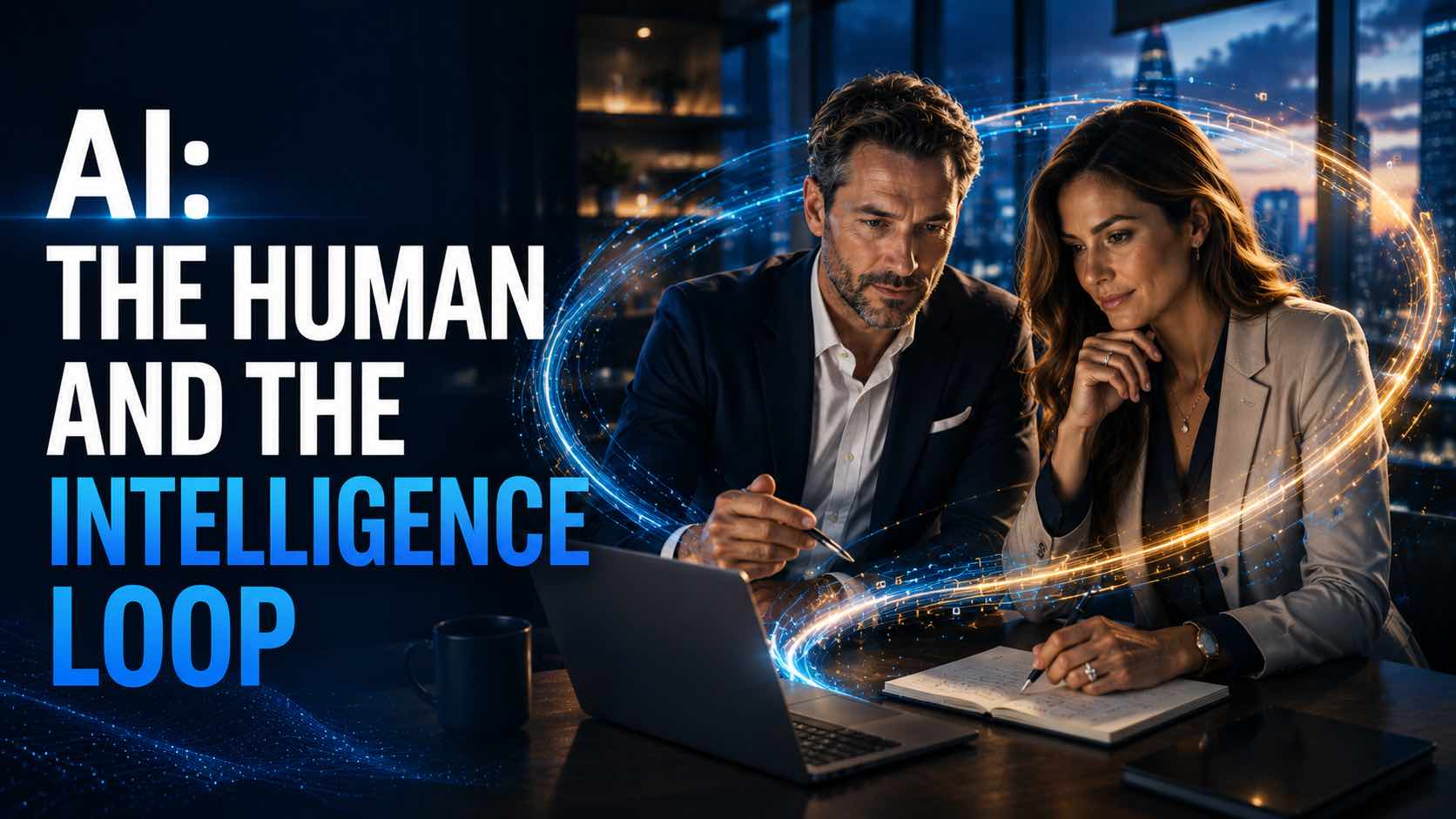
Why Human + AI leadership matters more than ever
Most businesses are still trying to figure out what AI is supposed to become inside the organization.
For some companies, AI is being treated like a productivity tool.
For others, it is becoming an automation layer.
Some are experimenting carefully.
Others are racing toward aggressive implementation without fully thinking through the consequences.
But underneath all of those conversations, a deeper tension is quietly emerging.
Many organizations are unintentionally moving toward:
- removing humans from the loop
- outsourcing judgment
- automating too aggressively
- fragmenting responsibility
- over-optimizing efficiency
- creating AI systems nobody truly owns
At first, some of this can look impressive.
Work moves faster.
Content gets produced quicker.
Tasks become easier to delegate.
Processes appear more streamlined.
But over time, many businesses begin noticing something else happening underneath the surface:
- confusion increases
- accountability weakens
- decisions feel disconnected
- output becomes shallow
- teams lose context
- trust starts to erode
- operational drift quietly expands
The business becomes faster in some areas, but less grounded overall.
That is the risk of designing AI systems that slowly push humans out of the decision environment instead of strengthening them inside it.
At YourBrandExposed, we continue arriving at a very different conclusion:
The human must remain present inside the intelligence loop.
Not outside it.
Not replaced by it.
Not buried underneath it.
Inside it.
That distinction matters far more than most people realize.
Because the goal of Human + AI collaboration should not be removing human leadership from the work.
The goal should be strengthening human capability inside increasingly complex business environments.
That changes how AI should function inside the company.
AI should:
- support
- prepare
- surface information
- organize complexity
- accelerate workflows
- reinforce continuity
- reduce cognitive overload
- help professionals maintain momentum
But humans still:
- judge
- decide
- lead
- contextualize
- protect
- communicate
- own consequences
- remain accountable
That is a massive philosophical difference.
A healthy Human + AI environment does not remove responsibility from people.
It strengthens people so they can operate more clearly under pressure.
This is where many AI conversations become overly simplistic.
Efficiency matters.
Automation matters.
Workflow improvement matters.
But if businesses optimize only for speed, they risk unintentionally weakening the very thing that makes organizations resilient in the first place:
human judgment connected to context, responsibility, and consequence.
Research from organizations like MIT Sloan, McKinsey, and the World Economic Forum increasingly points toward augmentation models where AI supports human capability rather than fully replacing professional decision-making. The strongest long-term outcomes often appear when AI helps humans operate at a higher level instead of removing them from the process entirely.
That aligns closely with what we see inside real business environments.
The companies creating the healthiest Human + AI systems are usually the ones that remain intentional about:
- ownership
- governance
- accountability
- escalation
- workflow clarity
- human oversight
- decision responsibility
They understand something important: AI can support the work, but the human still owns the mission.
That philosophy sits at the center of how we think about AI Assistants, Digital Teammates, and AI Executives at YourBrandExposed.
We do not believe the future belongs to businesses that remove humans from the intelligence loop.
We believe the future belongs to businesses that strengthen humans inside it.
At YourBrandExposed, we help businesses design Human + AI systems that support people, reinforce leadership, reduce overload, and create practical operational clarity without losing the human side of the business in the process.
Sometimes the most important AI decision a company can make is not what to automate. It is deciding where the human must remain present.
Written by Scott MacFarland, founder of YourBrandExposed, with Alex, his AI Partner, supporting Human + AI business growth.
#AlexandScottAI #YourBrandExposed #HumanPlusAI #AIAssistant #DigitalTeammate #AIExecutive #ThinkWithAI #AILeadership
Copyright 2026 YourBrandExposed, LLC.
Sources
MIT Sloan Management Review
When humans and AI work best together — and when each is better alone
https://mitsloan.mit.edu/ideas-made-to-matter/when-humans-and-ai-work-best-together-and-when-each-better-alone
McKinsey & Company
The economic potential of generative AI: The next productivity frontier
https://www.mckinsey.com/capabilities/tech-and-ai/our-insights/the-economic-potential-of-generative-ai-the-next-productivity-frontier
World Economic Forum
AI at Work: From Productivity Hacks to Organizational Transformation
https://reports.weforum.org/docs/WEF_AI_at_Work_from_Productivity_Hacks_to_Organizational_Transformation_2026.pdf
Image generated by OpenAI’s DALL·E via ChatGPT.