
Why AI adoption should be measured by business capability, not simply activity
For years, the hotel industry has understood an important lesson. More revenue does not automatically mean a healthier business.
A hotel can increase occupancy, raise rates, and generate more revenue, while higher labor costs, distribution expenses, acquisition costs, operating expenses, and other pressures quietly reduce profitability. That is why sophisticated hotel operators do not look at one number. They look deeper. They ask what is happening underneath the revenue.
I think business leaders need to start doing the same thing with AI.
Because right now, there is a lot of AI activity. Employees are using ChatGPT. Teams are experimenting with new platforms. Emails are being drafted faster. Research is being summarized. Content is being created. Meetings are being condensed. Companies are buying AI licenses and adding new tools. From the outside, it can look like tremendous progress. But is it?
AI activity is not the same as AI progress:
This is the question I think more executives need to ask: Is all of this AI actually making our people and our business more capable? Because simply increasing AI usage does not necessarily improve the organization.
A company can have hundreds of employees experimenting with AI and still have the same communication problems. The same disconnected information. The same overloaded managers. The same inconsistent sales preparation. The same difficulty finding institutional knowledge. The same slow decision-making. The same operational friction. In that environment, AI adoption may be growing while business capability barely moves. That should concern leadership.
The AI equivalent of watching revenue alone
Back to the hotel scenario. Imagine running a hotel (or a series of them), and only watching revenue. Revenue goes up, so everything must be working right? Hmm…
Experienced operators know better. You have to understand what is creating that revenue, what it costs to produce it, and whether the business is actually becoming stronger. AI deserves the same level of scrutiny.
- Do not simply ask: “How many employees are using AI?”
- Ask: What are they able to do better because of it?
- Do not simply ask: “How many hours did we save?”
- Ask: What new capacity did those hours create?
- Do not simply ask: “How many AI tools do we have?”
- Ask: Are those tools helping our people think, prepare, decide, and execute more effectively?
Those questions tell you much more about whether AI is becoming a meaningful business capability.
More AI is not necessarily better AI
This is where I believe many organizations are entering an uncomfortable stage. The experimentation phase has been successful. People discovered AI. They tried it. They found useful applications. That was necessary. But experimentation can eventually create another problem.
AI begins spreading through the company without much structure. Sales develops one approach. Marketing develops another. Operations experiments separately. Executives have their own tools and methods. Employees create personal workflows. I am sure you have probably seen this. Before long, the company has plenty of AI activity, but very little consistency around how AI should actually support the business.
Everyone is using AI. But nobody is quite sure what the organization is becoming better at. Now… be honest with yourself, if you’re a leader, have you thought about that yet? If you have, that is the point where AI needs to move from experimentation to a having a controlled, strategic usage plan.
Strengthen the Team
At YourBrandExposed, we believe AI should strengthen the professionals, not simply increase AI usage. That means looking at outcomes differently.
- Does AI create greater clarity around what matters?
- Does it increase capability by helping people perform work more effectively?
- Does it expand capacity so people can handle more information, opportunity, or complexity?
- Does it improve cognition by helping turn information into understanding?
- Does it create greater confidence because people are better prepared to make decisions?
Those are much more meaningful indicators of AI progress. Because the goal was never to have employees use more AI. The goal was to help people and organizations perform better.
Maybe the next AI question needs to change
For the last few years, business leaders have been asking: “How do we get our people using AI?” That was probably the right question at the beginning. I am not sure it is the right question anymore. The better question may now be: “What is our business becoming capable of because our people are working with AI?”
That changes everything.
- It changes how you think about AI strategy (if you have one).
- It changes how you train people.
- It changes how you evaluate workflows.
- It changes how you design AI Assistants and Digital Teammates.
And it moves the conversation away from technology adoption and toward business performance.
At YourBrandExposed, that is where we believe the real opportunity begins.
We work with organizations and help them determine where AI belongs, what it should support, and how Human + AI collaboration can strengthen the way people think, work, and make decisions. Because more AI is not the goal. A more capable business is.
Human + AI. Designed to Think and Work Together
Written by Scott MacFarland, founder of YourBrandExposed, with Alex, his AI Partner, supporting AI-powered business growth.
#AlexandScottAI #YourBrandExposed #HumanPlusAI #AIAssistant #DigitalTeammate #AILeadership
Copyright 2026 YourBrandExposed LLC.
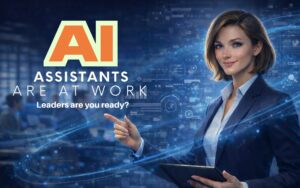
Image generated by OpenAI’s DALL·E via ChatGPT.