
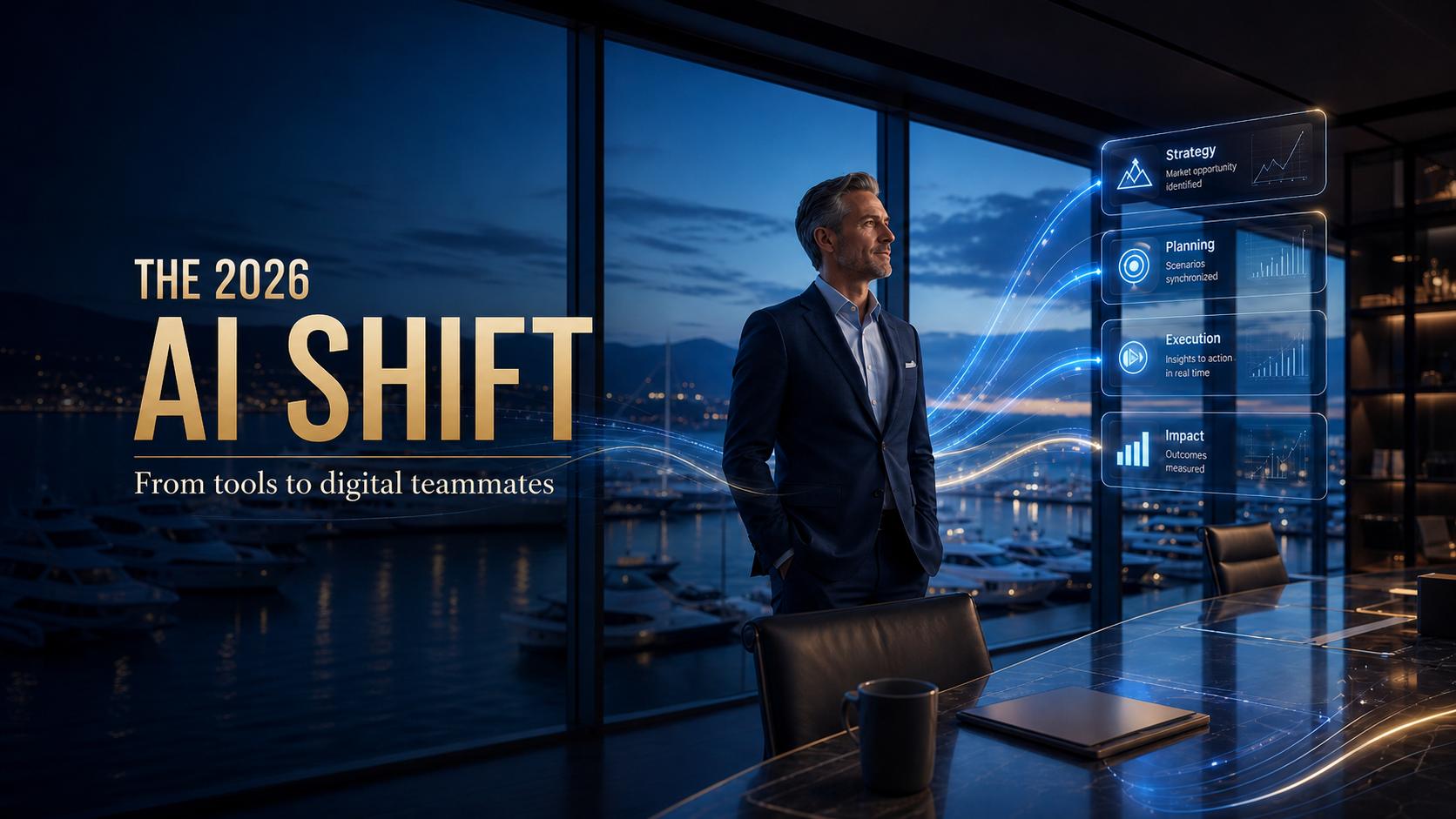
AI adoption is moving from scattered tool use to AI assistants, Digital Teammates and designed Human + AI working relationships.
Key Points
- AI adoption is moving beyond scattered experimentation and into a more serious business conversation.
- Some of the strongest companies are not just asking which AI tool to use. They are asking how people and AI should work together.
- AI Assistants and Digital Teammates are becoming more important because they can be designed around real people, real roles, real workflows, and real business decisions.
- In marketing and sales, AI alone is no longer the differentiator. The edge comes from clarity, trust, human judgment, and disciplined, collaborative execution.
And the future? It’s not full automation. It’s human-led AI support designed around the way real work actually happens and is managed. Yes, this is real work being done with the human driving the bus the entire time.
AI Video generated by Synthesia
For the last two years, most business conversations about AI have focused on access.
- Which platform should we use?
- Which model is best?
- Who on the team is experimenting?
- What should we automate first?
Those were fair questions when AI still felt new. But 2026 is changing the conversation.
The organizations gaining traction now are not simply using AI more often. They are becoming more intentional about how people and AI work together.
That is the real shift.
Not from one tool to another tool. But from AI use to designed Human + AI working relationships.
From prompts to practical AI support, thinking, working, solving, pressure testing, and executing… you get the idea.
From experimenting with AI to building AI Assistants and Digital Teammates around the way real work actually happens.
The data supports that shift. McKinsey’s 2025 State of AI research found that organizations capturing more value from AI are focused on more than tools. They are strengthening strategy, operating practices, technology, data, adoption, and scaling. McKinsey also notes that organizations are beginning to redesign workflows and place senior leaders in AI governance roles as they deploy generative AI.
In plain English, the serious AI conversation is moving beyond access and into how work is designed, governed, supported, and improved.
That matters because AI is no longer impressive just because it exists. Access is no longer rare. Capability is rising. Interfaces are improving. Teams are getting more comfortable. The baseline is moving up.
Which means the better question is no longer: “Do we use AI?”
The better question is: “Have we designed the right AI support around the people, decisions, fragmented workflows, and standards that actually drive our business?”
AI Is Moving Closer to the Way Real Work Gets Done
Many companies still think about AI as a tool, chatbot, or productivity shortcut.
That framing is already too small.
Way too small.
The more important development is that AI is starting to support the everyday work that keeps a business moving.
It means leaders need to stop treating AI like a separate tool sitting off to the side and start asking better questions.
- Where does information enter the business?
- Where do people lose time?
- Where does follow-up break down?
- Where are decisions delayed?
- Where does important knowledge live only in someone’s head?
- Where could an AI Assistant help a person work with more clarity, consistency, and capacity?
Those are not IT questions.
Those are serious business questions.
And they are exactly where the AI Assistant and Digital Teammate conversation becomes more practical and more real.
The Shift From Prompting to Guided AI Support
One of the clearest patterns emerging now is the move from prompting to more guided AI support.
That language can get overcomplicated, but the practical meaning is simple.
Instead of asking AI for one isolated output, businesses are starting to use AI to support connected work and connected thinking.
- Research.
- Context.
- Drafting.
- Organization.
- Market understanding.
- Competitive awareness.
- Testing new approaches.
- Developing new methods.
- Preparation
- Follow-up support.
- Second and third-order thinking.
- Next-step clarity.
- Many other forms of practical business support.
That is a very different posture than asking for a blog title or a sales email. It changes what business professionals should evaluate.
The real question is not whether AI can generate something decent. The real question is whether AI can support work in a way that is structured, supervised, useful, and aligned with how the business operates in real time.
This means, at 10 p.m. when an idea hits you regarding tomorrow’s important meeting, you are not waiting until the next day to “figure it out with the team.” You are getting it done when the idea flashes in your head as “hey, we could do this.” Those moments do not always happen between 9 and 5 because you’re bombarded with messages, calls, emails, meetings and work.
With an AI Assistant, you have the power to think through the idea, shape it, and bring it to life in a form you can present to the team tomorrow morning. Will a generic AI tech stack do that by itself? Not usually.
This allows you to have the ability to pivot on demand when the idea is at the most critical point, while it is fresh.
That is where this next phase gets serious.
The companies that do this well will not simply be the ones with access to powerful AI. They will be the ones that understand context, responsibility, review, judgment, and the real human + AI part of execution.
And yes, they will understand how an AI Assistant can help solve that dilemma.
That difference matters.
And the working relationship with your AI Assistant matters even more.
Deloitte has warned that agentic AI is scaling faster than many organizations’ guardrails. Its research points to the need for clearer boundaries, human approval rules, monitoring, and audit trails as AI becomes more capable of participating in sequences of work. Deloitte also reported that only 21% of surveyed enterprises had mature governance in place for agentic AI at the time of publication.
That reinforces the point:
The future is not just more powerful AI.
It is better-designed Human + AI collaboration and workflow management.
Human Judgment Is Becoming More Valuable, Not Less
This is the part too many people still miss.
As AI makes average output easier to produce, human judgment becomes more valuable.
- When more people can generate content, positioning matters more.
- When more teams can scale outreach, trust matters more.
- When more businesses can summarize information, interpretation matters more.
- When more work can move faster, clarity matters more.
Here are the key points many people miss because AI is making business easier in some ways and harder in others when the human and AI are not collaborating with discipline:
- Human judgment
- Positioning
- Trust
- Interpretation
- Clarity
The future is not human versus AI. It is Human + AI, with clear standards.
The strongest businesses are using AI to remove friction and reskill teams, but they are not removing the human accountability.
They are using AI to accelerate execution, but they are not outsourcing thought.
They are using AI to expand capacity, but they are not giving away brand voice, customer empathy, or decision ownership.
That is a major distinction.
AI can make good businesses sharper.
It can also make messy businesses louder, more fragmented, and more exposed.
And that is a terrible bargain.
In practice, teams need more than access.
They need rules of engagement.
- What must be reviewed by a human?
- What can move faster?
- What tone is acceptable?
- What sources are trusted?
- What decisions require escalation?
- What gets documented?
- What gets measured?
These are leadership questions.
And in 2026, leadership quality is becoming one of the biggest multipliers in AI performance.
The World Economic Forum has made a similar point in its AI workforce research, emphasizing that organizations need to move beyond small pilots and rethink workflows, trust, workforce practices, and organizational structures as AI becomes more embedded in daily operations.
Marketing and Sales Are Growing Up Fast
Marketing and sales are still two of the clearest proving grounds for AI, and the maturity curve is changing quickly.
A year ago, many teams were impressed simply because AI could write faster. Now the smarter teams understand that speed without positioning creates more noise, not more pipeline.
The real advantage comes when AI helps teams do better work, faster work, and creates more capacity. That’s the hidden value that is not considered… yet. It’s coming, however.
That includes sharper messaging, more consistent follow-up, better preparation, clearer customer understanding, improved content discipline, and stronger support around the work that connects strategy to execution. Some of these we already mentioned.
McKinsey’s 2025 AI research points to marketing and sales as one of the areas where organizations are commonly applying generative AI, while also emphasizing that value capture depends on re-thinking workflows, governance, talent, and operating practices around AI adoption.
But none of that works well without a strong point of view.
- If your brand sounds generic, AI can help you sound generic at scale.
- If your sales process is sloppy, AI can amplify the sloppiness.
- If your team lacks message discipline, AI can create more variation and customer confusion than value.
That is why strong businesses are pairing AI adoption with tighter positioning, clearer offers, better enablement, and more disciplined content workflows connected to real human counterparts.
HubSpot’s 2026 State of Marketing research points in the same direction, framing AI as a baseline rather than the differentiator and emphasizing that human-led marketing, trust, authenticity, creativity, and a sharper brand point of view matter more as AI increases content volume.
AI does not replace market clarity. It punishes the lack of it.
Real Estate, Marine, and Yachting Make the AI Conversation More Tangible
One of the best ways to understand where AI is heading is to watch industries where technology has to prove itself in the real world.
Real estate, marine, and yachting are useful examples.
In these industries, AI is not just an abstract software conversation.
It connects to practical business realities, real customers, complex decisions, and high-value moments where trust and key knowledge matter.
In real estate, AI can support work around community differences, buyer and seller needs, property positioning, market research, follow-up, and communication.
In marine and yachting, AI can support work around buyer needs, listing information, market comparison, owner communication, high-value closing negotiations, service coordination, sales preparation, follow-up, and decision support.
That makes the lesson bigger than homes and boats.
AI becomes valuable when it reduces complexity without creating new confusion.
- If a tool is hard to trust, adoption suffers.
- If technology weakens awareness, risk rises.
- If smart systems create dependence without clarity, people pull back.
That is a useful reminder for every industry.
The point is not to make AI look impressive.
The point is to make work better, clearer, and more dependable under real conditions.
Every business needs AI that supports human judgment rather than trying to bypass it completely.
5 Tips for What Leaders Should Do Now
If you are leading a business in 2026, the starting point is not another random AI experiment.
If you are doing that, STOP! There is a clearer way of thinking about where AI support belongs.
Tip #1: Stop Thinking in Isolated Prompts
- Stop thinking in isolated prompts and start paying attention to real work, real challenges, real painful gaps, and the intersection points where you make money and lose money.
- Look for places where repeated decisions, repeated handoffs, repeated content needs, repeated knowledge retrieval, and repeated follow-up create friction.
- That is often where AI support becomes practical.
Tip #2: Define the Human Standard Before You Add AI
- What does good look like in your business?
- What cannot be compromised?
- What must remain owned by a person?
- AI should support your standards, not blur them.
Tip #3: Design Around Roles, Not Random Tools
- A useful AI Assistant or Digital Teammate should have a clear purpose.
- It should support a real person, a real responsibility, or a real business function.
- That is very different from giving everyone a tool and hoping value appears.
Tip #4: Tighten Your Brand Point of View
- As AI-generated content expands, distinctiveness matters more.
- Businesses that know what they stand for will be in a stronger position than businesses that simply publish more.
Tip #5: Train Your Team to Work With AI Deliberately
- Get training for your team to work with AI deliberately, especially if they are not working with an AI Assistant.
- That is when they may be at the most risk.
- The skill is no longer just prompting.
- It is framing, reviewing, validating, correcting, escalating, and improving over time.
- That is how AI stops being a toy and starts becoming a real business advantage.
Final Thought
The companies that gain serious advantage with AI in 2026 will not be the loudest. They will be the clearest. They will understand that AI is not a shortcut around leadership.
It is a force multiplier for the quality of leadership already in place.
- If your workflows are messy, AI often exposes it.
- If your standards are weak, AI will magnify it.
- If your strategy is vague, AI can scale that confusion and hurt you, not help.
But if your business is clear, disciplined, and well-led, AI can help your people operate with more consistency, responsiveness, and capacity than they had before.
That is the real shift.
Not tools.
Not hype.
Not AI experiments.
Designed AI Assistants.
Human judgment.
Digital Teammates, not AI vending machines.
That is where the next serious advantage is being built right now.
_________________
Written by Scott MacFarland, founder of YourBrandExposed, with Alex, his AI Partner, supporting AI-powered business growth.
#AlexandScottAI
#YourBrandExposed
#HumanPlusAI
#AIAssistant
#DigitalTeammate
#AILeadership
#SalesAndMarketing
#FutureOfWork
Copyright 2026 YourBrandExposed LLC.
AI content and video disclosure:
Some YourBrandExposed content, videos, visuals, and educational materials may be created and/or supported using AI tools, including ChatGPT. Videos may include AI-generated narration, visuals, or a synthetic presenter. The Alex presenter shown in YourBrandExposed video content is synthetic and created using Synthesia. Alex, YourBrandExposed’s AI Partner, is created and supported using ChatGPT. Any avatar or synthetic presenter is used for narration and presentation purposes only and does not represent a human employee or official human spokesperson of YourBrandExposed. Content is created and reviewed by YourBrandExposed to provide practical Human + AI business education.
Sources
Image generated by OpenAI’s DALL·E via ChatGPT.
AI Video generated by Synthesia.
McKinsey & Company, The State of AI: How Organizations Are Rewiring to Capture Value
Deloitte, Agentic AI Is Scaling Faster Than Guardrails
World Economic Forum, AI at Work: Insights From 20 Leading Technology Companies
World Economic Forum, Organizational Transformation in the Age of AI